
Services · IoT device platforms
Reference Design & Development Platforms
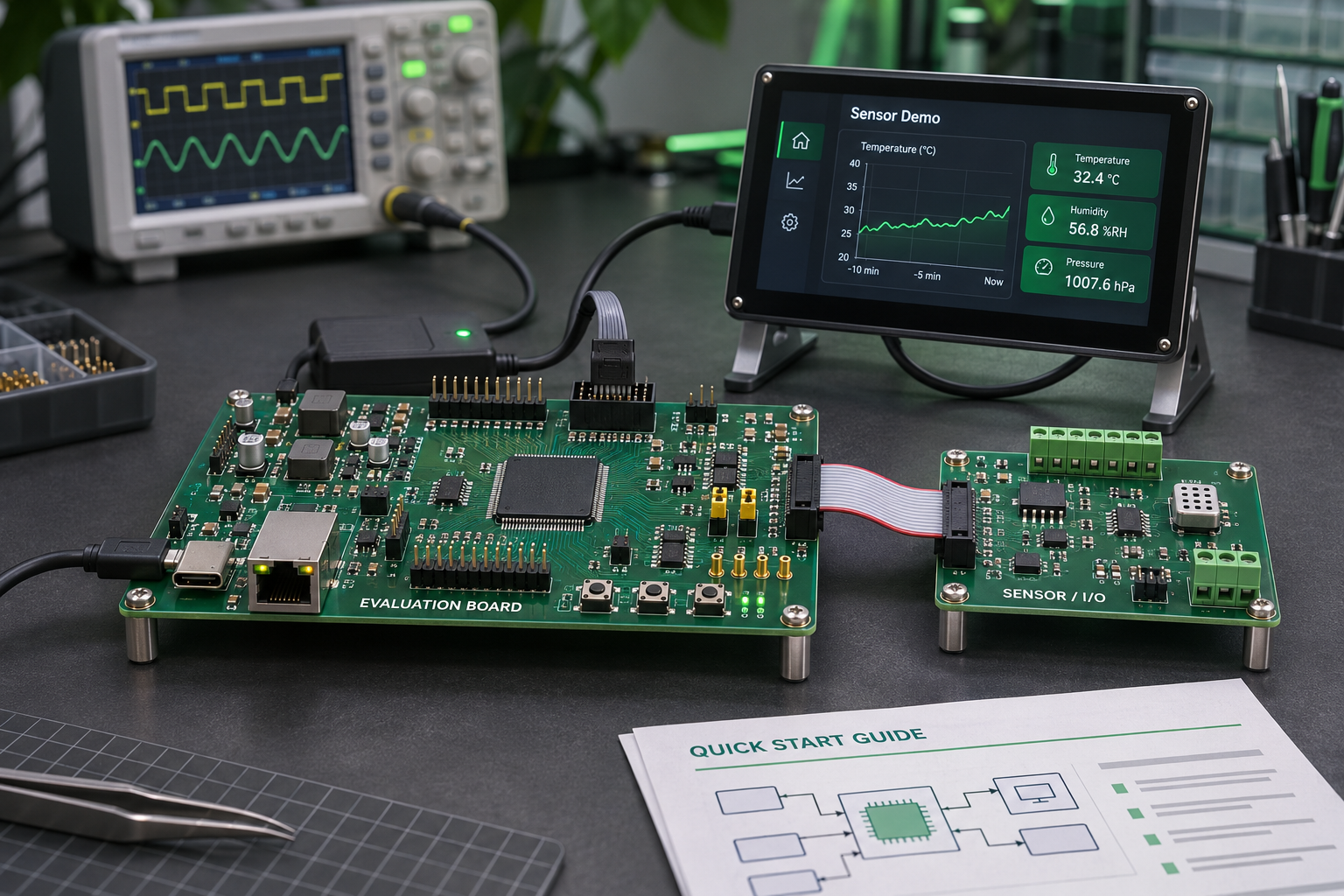
Turn semiconductor and module capabilities into platforms that engineers can evaluate, demonstrate and adapt. Hardware, software examples and documentation are developed around a clear use case to support the path from component selection to product integration.
Common problems
The problem to solve.
A datasheet or general-purpose evaluation board may not demonstrate the application a customer needs. Engineering teams still have to connect peripherals, adapt firmware, verify interfaces and prepare a repeatable demo. Incomplete documentation and unclear design assumptions make evaluation and reuse harder.
Bambootronics develops platforms around the target IC or module, intended users and evaluation objectives. Depending on the project, the deliverable may be a component evaluation board, an application reference design, an expansion board, a demonstration kit or a custom SBC. Hardware, firmware and documentation are developed against agreed acceptance criteria. The scope defines what will be demonstrated, how it will be tested and which design assets will be delivered for further development or production.
Core capabilities
What the engineering team does.
- 01
Evaluation & development boards
Expose the interfaces, debug access and measurement points needed to evaluate the selected device
- 02
Application reference designs
Combine hardware and demo firmware around a defined application
- 03
Expansion & interface boards
Add sensing, connectivity, power, display or industrial I/O to an existing platform
- 04
Custom SBCs
Define computing, peripheral interfaces and embedded Linux support around project requirements
- 05
Demo & solution kits
Package hardware, software examples and setup instructions for repeatable demonstrations
- 06
Documentation & verification
Record setup procedures, test results and known limitations to support reuse
What you get
- Evaluation objectives, application scope and acceptance criteria
- System block diagram and interface specification
- Schematics, PCB layout, BOM and manufacturing files as agreed
- Assembled prototypes with board bring-up and test reports
- Demo firmware, drivers or BSP configuration within the agreed scope
- Quick Start Guide, connection instructions and demonstration procedure
- Known limitations and recommendations for further integration
- Source files, build instructions and usage rights as defined in the contract
- Production and test package when included in the project
Information
- Platform types
- Evaluation board, development board, application reference design, expansion board, demo kit and custom SBC
- Target IC or module
- Selected according to project requirements and available technical support
- Embedded software
- Bare-metal, RTOS or embedded Linux according to the selected platform
- Interfaces
- Sensing, connectivity, display, power and industrial I/O as specified
- Customization
- Board dimensions, connectors, power architecture, peripherals and demonstration functions
- Verification
- Test scope and acceptance criteria agreed before implementation
- Production
- Prototype and repeat-build support through coordinated EMS partners
- Design rights
- Ownership, reuse, publication and distribution defined in the contract
Delivery process
Next steps.
- 1
Define target users, selected ICs or modules, application scenarios and evaluation objectives
- 2
Review available documentation, SDKs, reference designs and technical dependencies
- 3
Agree on system architecture, interfaces, demonstration scope and acceptance criteria
- 4
Develop hardware, firmware and documentation with coordinated design reviews
- 5
Build prototypes, bring up peripherals and verify the agreed demonstration scenarios
- 6
Deliver the design package and support kit production or further integration as agreed
Before you start
Frequently asked questions.
Right for your project?
Send a few lines about your application and quantity. Bambootronics replies with clarifying questions and a suitable configuration direction.